
READ MORE BLOGS

DE-ICING SOLUTIONS • Winter Maintenance
De-Icing Solutions for all conditions
De-icing solutions help winter maintenance teams loosen or melt snow and ice after it forms, while anti-icing treatments are used before or near the start of a storm to help prevent frozen precipitation from bonding to the surface. The right approach depends on pavement conditions, storm timing, treatment area, equipment, storage, and the supported operating range of the selected product.

Planned for Real Conditions
What Are De-Icing Solutions?
De-icing solutions are liquid or granular materials applied to help melt, loosen, or manage snow and ice on a surface. They are used on roadways, bridges, parking lots, loading areas, sidewalks, and other priority surfaces where frozen precipitation can disrupt winter operations.
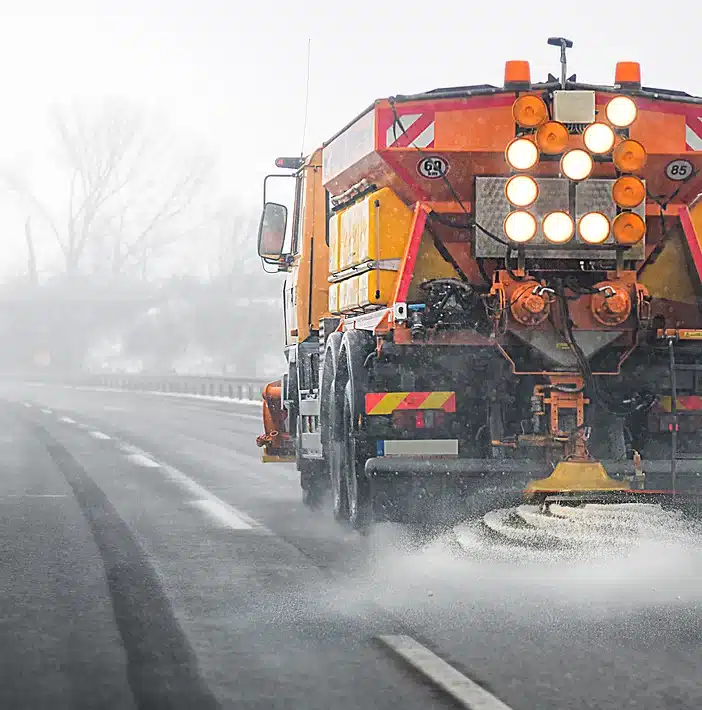
Different chloride blends and product formats behave differently under winter conditions. Granular products place solid material on the surface and are commonly used where existing ice or packed snow must be treated. Liquid products can be applied through spray equipment for anti-icing, de-icing, or route-specific operations when the product instructions and field conditions support that use.
Limit Bonding
Anti-icing treatments are planned to help keep snow and ice from forming a strong bond with the pavement.
Loosen Existing Ice
De-icing materials are used after frozen precipitation is present to support melting, loosening, and removal.
Support Route Response
Product format, application rate, loading time, and retreat needs all affect how efficiently a crew can cover priority areas.
What Is the Difference Between Anti-Icing and De-Icing?
Anti-icing is a preventive treatment applied before or near the beginning of a winter event to help reduce bonding between frozen precipitation and the surface. De-icing is a reactive treatment applied after snow or ice has formed or bonded, with the goal of loosening or melting that material so crews can manage or remove it.
Anti-icing and de-icing at a glance
| Decision | Anti-Icing | De-Icing |
|---|---|---|
| Timing | Before or near the start of an event | After snow or ice is present |
| Primary objective | Help limit bonding to the surface | Help loosen or melt existing frozen material |
| Main inputs | Forecast, pavement condition, lead time, and route priority | Observed conditions, accumulation, plowing, traffic, and pavement temperature |
| Operational focus | Prepare the surface before conditions deteriorate | Restore service while coordinating treatment and removal |
Many winter programs use both strategies. A crew may pretreat selected bridges, hills, intersections, entrances, or high-priority lanes, then switch to de-icing as precipitation accumulates and conditions change. Rain before a freeze, blowing snow, heavy accumulation, refreeze, and rapidly falling pavement temperatures can all change the correct timing and material choice.
Planning these actions separately helps teams define when to mobilize, what material to load, which routes receive priority, and what field observations trigger a change in treatment. Envirotx provides a more detailed preseason de-icing planning checklist for teams building an operating plan before the first storm.
Should You Use a Liquid or Granular Deicer?
Neither format is the best choice for every operation. Liquid deicers and brine additives can support planned coverage through spray systems, while granular products can place solid melting material directly on surfaces that already have snow or ice. Many winter maintenance programs keep both formats available because storm stage, route type, equipment, and service goals change.
Liquid and granular deicer comparison
| Factor | Liquid Products | Granular Products |
|---|---|---|
| Common fit | Pretreatment, early-event application, brine enhancement, and spray-route coverage | Treating existing snow or ice on roads, lots, walkways, and targeted problem areas |
| Equipment | Tanks, pumps, plumbing, calibrated nozzles, and compatible spray systems | Calibrated spreaders, loaders, material handling equipment, and protected stockpiles or bags |
| Storage questions | Tank compatibility, mixing or dilution instructions, freeze protection, and spill control | Moisture protection, caking or bricking risk, flow characteristics, and loading access |
| Selection priority | Application timing, surface retention, pumping, route design, and supported temperature range | Melting performance, particle distribution, spread rate, storage behavior, and supported temperature range |
Product labels, current technical data, safety data sheets, and supplier guidance should control the final application plan. Air temperature alone is not enough: pavement temperature, moisture, precipitation, traffic, and plowing activity describe the surface environment more accurately.
Which Envirotx De-Icing Solutions Fit Different Winter Operations?
Envirotx offers TORCH granular products, TORCH LT liquid deicer, a High Performance Complex Chloride, and a Liquid Brine Additive. The options are intended for different combinations of road maintenance, commercial property treatment, material handling, lower-temperature performance, and brine enhancement.
TORCH granular de-icing products
- TORCH™ RT (Rapid Thaw): A blend of natural granular deicers and chlorides positioned by Envirotx as its premier granular product for demanding winter road maintenance. Envirotx lists performance down to -20°F for this product.
- TORCH™ RS (Rocanville Standard™): A multi-chloride product containing sodium, magnesium, calcium, and potassium chlorides. Envirotx reports an active chloride level of 99.3% to 99.6% and positions RS for performance at lower temperatures and reduced application rates compared with typical road salt.
- TORCH™ SD: A bagged, multi-chloride granular deicer formulated for commercial parking lots and other operations that need packaged material for targeted application.
- TORCH™ Xtreme: A kiln-dried, multi-chloride product with less than 1% total moisture. Its low-moisture design is intended to support free-flowing handling from stockpiles, bulk super sacks, and application equipment.
TORCH™ LT Liquid Deicer
TORCH LT is designed for stable storage and application performance, lower-temperature operation, and reduced application rates where the current product guidance supports those uses.
High Performance Complex Chloride
This fast-acting compound is intended for highway and street de-icing. Envirotx reports at least 20% less corrosion than white salt and lighter spread rates that can extend route coverage.
Liquid Brine Additive
This liquid inhibitor and salt brine enhancer is designed to improve surface bonding. Envirotx reports that a 1:1 ratio lowers the freezing point from 18°F to 11°F and decreases corrosion by 70% compared with rock salt.
Review the complete Envirotx anti-icing and de-icing product line for current product descriptions and available safety data sheets.
How Do You Choose the Right De-Icing Product?
Start with operating conditions, not a product name. The useful question is: which product can be stored, loaded, applied, monitored, and replenished reliably for the surfaces and storm conditions your team must manage?
De-icing product selection checklist
- Define the surfaces: List roadways, bridges, hills, intersections, parking lanes, loading docks, entrances, and walkways by priority.
- Separate treatment timing: Decide where anti-icing is practical and where crews primarily need post-formation de-icing.
- Use pavement conditions: Consider pavement temperature, precipitation, moisture, accumulation, refreeze risk, and plowing activity.
- Match the equipment: Confirm that tanks, pumps, nozzles, spreaders, loaders, and controls are compatible and calibrated for the material.
- Plan storage and handling: Review moisture protection, tank requirements, stockpile flow, loading access, spill procedures, and crew handling instructions.
- Compare total route performance: Evaluate supported application rate, route coverage, loading and refill time, retreat needs, material availability, and delivered cost.
- Verify current documentation: Use the latest product data, safety data sheet, and supplier instructions before finalizing the operating plan.
The lowest price per ton or gallon may not represent the lowest operational cost. A useful comparison also accounts for the supported spread or spray rate, lane miles covered, number of reloads, labor, equipment time, storage losses, and the likelihood of retreating priority areas. Those variables must be evaluated for the actual product and route plan rather than assumed from the product format alone.
Talk to a Roadway Specialist
How Envirotx Helps Teams Build a Practical Ice Control Program
Envirotx is a roadway and site solutions supplier serving construction and maintenance operations, including DOTs, counties, cities, contractors, and commercial property teams. For winter maintenance, Envirotx helps customers compare liquid and granular de-icing products based on storm conditions, surfaces, equipment, storage, route needs, and purchasing requirements.
That product-matching step matters because a single material does not answer every winter maintenance problem. Rural routes, urban intersections, commercial lots, pedestrian areas, and high-priority facilities can require different material formats and response plans. A clear request allows the Envirotx team to narrow the options without assuming that every operation needs the same product.
Information to include in a de-icing product request
- Surface types and approximate treatment area or route mileage
- Typical storm conditions and pavement temperatures, when known
- Whether the program needs anti-icing, de-icing, or both
- Available liquid and granular application equipment
- Storage capacity, loading process, and delivery location
- Priority areas, expected response windows, and resupply needs
- Anticipated quantity and purchasing schedule
Frequently Asked Questions About De-Icing Solutions
What is the difference between an ice melt and a deicer?
Ice melt and deicer are often used as general terms for materials that help melt or loosen frozen precipitation. The more important distinction is the product's formulation, format, supported temperature range, application instructions, and intended surface or use case.
Are liquid deicers better than granular deicers?
No single format is better for every operation. Liquids can fit pretreatment and spray-route programs, while granular products can fit existing snow and ice, targeted applications, and operations built around spreaders. Many programs use both.
Why does pavement temperature matter for de-icing?
Pavement temperature helps determine whether a product is being used within its supported operating range at the surface. Air temperature alone may not reflect the condition of a bridge deck, shaded roadway, parking lot, or walkway.
Can the same product be used for anti-icing and de-icing?
Some products may support both uses, but teams should follow the current instructions for the specific product. Pretreatment and post-formation de-icing can require different timing, rates, equipment settings, and field checks.
How should de-icing products be compared?
Compare products by supported temperatures, application rates, route coverage, equipment compatibility, storage requirements, surface fit, loading time, retreat needs, availability, and delivered cost. Verify published claims against current technical documents.
When should a winter maintenance team order de-icing material?
Product selection and procurement should be completed before the first forecast creates an urgent need. The exact timeline depends on regional weather, purchasing requirements, storage readiness, delivery lead time, and expected seasonal volume.
Match the Product to the Storm, Surface, and Operation
A dependable winter maintenance program connects material choice with treatment timing, pavement conditions, route priorities, equipment, storage, and resupply. Contact Envirotx to compare liquid and granular de-icing solutions for your roads, parking lots, walkways, and other priority surfaces.
Talk to a Roadway SpecialistTorch De-icing Solutions
When extreme weather hits, Envirotx effective and proven lines of de-icing solutions are here to help. We fight ice on contact, stop ice from bonding to surfaces, and prevent water from freezing. Each storm provides unique challenges that need unique solutions. Whether you need bulk sodium or a designer ice melt, we have a solution for you. Our liquid and granular deicing products are derived and colored naturally, because nature provides us with the best ingredients available.
TORCH DE-ICING
When extreme weather hits, Envirotx effective and proven lines of de-icing products are here to help. We fight ice on contact, stop ice from bonding to surfaces, and prevent water from freezing. Each storm provides unique challenges that need unique solutions. Whether you need bulk sodium or a designer ice melt, we have a solution for you. Our liquid and granular deicing products are derived and colored naturally, because nature provides us with the best ingredients available.
TORCH™ RT
is our premier granular product for winter road maintenance, TORCH™ RT (Rapid Thaw) is an all-natural, environmentally friendly, uniquely colored granular de-icer specifically engineered to perform in the toughest winter conditions. TORCH™ RT is a blend of natural granular de-icers and chlorides designed to last longer, work faster, and melt more than conventional granular de-icers.
TORCH™ RS
(Rocanville Standard™) is a multi-chloride granular deicer containing sodium, magnesium, calcium and potassium chlorides. These chlorides combined with extremely low insolubles, produce an active chloride level between 99.3% – 99.6%. The combination of the chlorides and the high purity of the product, allow the product to perform longer and at lower temperatures than common road salts.
TORCH™ SD
TORCH™ Xtreme
Other De-Icing Products:
Envirotx High Performance Complex Chloride, is a fast-acting deicing compound, ideal for general highway and street deicing. In the first 30 minutes after application, the product effectively melts more snow and ice than white salt.
Our Complex Chloride is easier on equipment and infrastructure since it is at least 20% less corrosive than white salt. As a natural blend, our product will not stain concrete or asphalt. Its light spread rates can greatly increase your response time, as you will be covering as many as 5 times the lane miles per spreader. Additionally, utilizing anti-icing practices can create an even safer environment for the operators and public. Our Complex Chloride creates operational freedom, giving you the time and capability to cover more area, and retreat high profile areas sooner.
Envirotx Liquid Brine Additive is a liquid inhibitor and salt brine enhancer and breakthrough in deicing technology. Because salt brine alone is prone to drying out and being swept from the road’s surface, they have very identifiable performance limitations. It increases how effectively the product bonds to the surface and creates safer road conditions.
It also boosts melting power by lowering the product’s freezing point (1:1) from 18℉ to 11℉, and decreases corrosion by 70% as compared to rock salt. This product has undergone extensive testing to validate its effectiveness and clearly define how it is best utilized.