
READ MORE BLOGS


HIGH-PI CLAY • Soil Stabilization
Why High-Plasticity Clay Soils Are Difficult to Stabilize
High-plasticity clay soil stabilization is difficult because the roadbed is not simply weak. It is moisture-sensitive, volume-change prone, and often capable of moving enough to damage the base and surface above it.
For public works teams, engineers, contractors, and heavy-use road owners, high-PI clay should be evaluated before a stabilizer is selected. The right approach depends on soil behavior, drainage, compaction, traffic loading, and whether the project needs subgrade improvement, base support, dust control, or surface preservation.
Roadbed Evaluation
Why Are High-Plasticity Clay Soils Difficult to Stabilize?
High-plasticity clay soils are difficult to stabilize because they change behavior as moisture changes. When wet, they can soften, swell, pump, and lose support. When dry, they can shrink, crack, and leave voids that make the road structure less uniform.
Plasticity Index, often shortened to PI, is a soil test value that helps describe how much a fine-grained soil can change from a workable state to a more liquid or more brittle state as its moisture content changes. A higher PI usually means the clay has a wider moisture range where it behaves plastically.
For road owners, that matters because high-PI clay can move beneath the surface. A roadway may be graded correctly and still fail if the subgrade swells after rain, dries and shrinks during hot weather, or loses bearing capacity under repeated traffic.
Moisture Sensitivity
High-PI clay can gain or lose strength quickly as water enters, leaves, or moves through the soil layer.
Shrink-Swell Movement
Expansive clay can swell when wet and shrink when dry, creating movement that affects the roadway above it.
Compaction Risk
If moisture is not managed near the right working range, crews may struggle to achieve a stable, uniform compacted layer.
What Roadway Problems Does High-PI Clay Create?
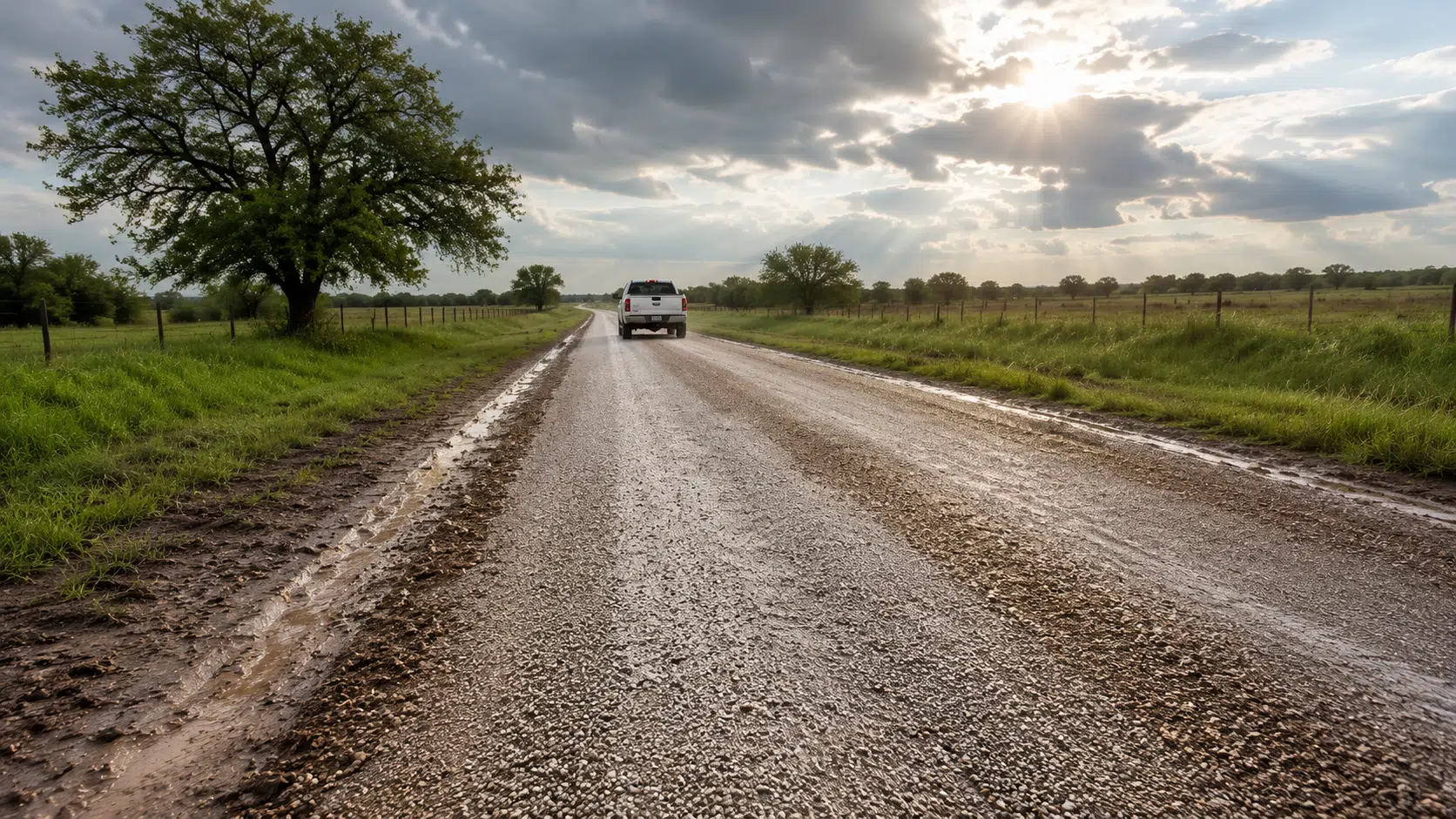
High-PI clay can create recurring roadway problems because it affects the support system below the surface. Crews may see rutting, pumping, edge deformation, soft spots, cracking, potholes, washboarding, or repeated failures in the same sections after wet and dry cycles.
These problems often return because the visible defect is only the surface expression of a subgrade issue. A patch, regrade, or additional aggregate layer may improve the road temporarily, but the underlying clay can continue to move and weaken when moisture conditions change.
Common signs that clay is influencing road performance
- Ruts form quickly after rain or heavy vehicle traffic.
- Soft areas pump water or fine material under repeated loading.
- The road surface heaves, settles, or cracks in recurring patterns.
- Additional aggregate disappears into weak or wet subgrade sections.
- Maintenance crews keep repairing the same segment after weather changes.
High-PI clay is especially important on county roads, oilfield access roads, mining roads, industrial yards, and other heavy-use sites where traffic loading is frequent and downtime is expensive. The heavier the load and the weaker the moisture control, the more important it becomes to understand the soil before choosing a treatment.
What Must Stabilization Address in High-PI Clay?
A high-PI clay stabilization strategy should address more than surface firmness. It should consider how the soil handles water, how it compacts, whether it can support the intended traffic, and whether the chosen treatment is compatible with the soil chemistry and project conditions.
Moisture control is one of the most important field variables. If the clay is too dry, it may not compact uniformly. If it is too wet, it may pump, smear, or fail to build the density needed for long-term support. Optimum moisture content should be treated as a project control point, not a minor detail.
Request Technical DataDrainage
Water movement should be managed so treated layers are not constantly softened or undermined.
Moisture and Compaction
The soil should be worked at a practical moisture range and compacted consistently across the treatment depth.
Soil Compatibility
Clay content, gradation, sulfates, organic material, and other soil characteristics can affect treatment selection.
Stabilization should also be matched to the roadway layer being corrected. A subgrade problem, a base problem, and a surface dust problem are not the same decision. Treating the wrong layer can leave crews with a road that looks improved at first but continues to fail under weather and traffic.
How Should Teams Evaluate a Stabilizer for High-PI Clay?
Teams should evaluate a stabilizer for high-PI clay by starting with the road problem, not the product name. The first question is whether the failure is coming from the subgrade, base, surface, drainage system, traffic load, or a combination of factors.
From there, the project team can review soil test information, treatment depth, moisture conditions, expected traffic, equipment access, curing needs, and maintenance goals. For specification-sensitive projects, lab testing or a field trial may be appropriate before committing to a full-scale treatment.
High-PI clay stabilization evaluation checklist
- Confirm whether the road problem is subgrade movement, base weakness, surface instability, or drainage-related.
- Review available soil data, including plasticity, clay content, gradation, and moisture behavior.
- Evaluate whether the road needs deeper stabilization, surface binding, reduced permeability, or a combined strategy.
- Plan the application around moisture control, blending depth, compaction, and curing conditions.
- Ask what training, technical support, and project-fit guidance are available before crews mobilize.
This is where high-PI clay work differs from routine grading. The goal is not only to make the road passable today. The goal is to reduce the conditions that cause repeated rutting, pumping, moisture damage, and shape loss after the next weather cycle.
How Envirotx Helps Evaluate High-PI Clay Stabilization Options
Envirotx provides roadway and site solutions for construction and maintenance, including dust control and soil stabilization technologies for subgrades, bases, unpaved roads, access roads, and industrial sites. The company supports projects from the working platform through final surface performance.
Envirotx DCE™ is an enzyme-based soil stabilization technology designed to help create a denser, more compacted road base when blended into suitable soils and properly compacted. Envirotx product information describes DCE as a bio-enzymatic stabilizer that supports improved density, load-bearing capacity, and moisture resistance in appropriate applications.
TOP-SEAL WHITE and TOP-SEAL BLACK are liquid polymer soil stabilizer solutions designed to bind, strengthen, and transform the base into a solid yet flexible surface. Envirotx positions these products for reducing dust, mud, base failure, soil erosion, moisture penetration, and permeability while supporting road base performance.
Where Envirotx support can be useful
- County and municipal roads with recurring rutting or soft subgrade sections
- Oilfield, mining, and industrial access roads exposed to heavy loads
- Roads where moisture-sensitive clay causes seasonal movement or pumping
- Projects comparing enzyme-based, polymer-based, lime, cement, or blended stabilization options
- Crews that need jobsite or classroom technical training before using newer roadway materials
Frequently Asked Questions About High-PI Clay Soil Stabilization
What is high-plasticity clay?
High-plasticity clay is clay soil that changes behavior significantly as moisture content changes. In road work, it matters because it can swell, shrink, soften, crack, and lose support beneath the base or surface.
Why does high-PI clay cause road failure?
High-PI clay can cause road failure because it is sensitive to moisture and volume change. When it gets wet, it may soften or swell; when it dries, it may shrink and crack. That movement can reduce support for the roadway above it.
Can high-PI clay be stabilized?
High-PI clay can often be improved, but the right approach depends on soil characteristics, water movement, compaction, treatment depth, traffic loading, and project goals. Testing and technical review are important before selecting a stabilizer.
Is enzyme-based stabilization always right for clay soils?
No. Enzyme-based stabilization should be evaluated for soil compatibility and field conditions. Envirotx DCE™ is designed for suitable soils with adequate clay content and proper compaction, but high-PI clay still requires project-specific review.
When should a public works team ask for help with high-PI clay?
A public works team should ask for help when the same road sections repeatedly rut, pump, heave, crack, or fail after weather changes. Those symptoms may indicate a subgrade or base issue that routine grading will not solve by itself.
Stabilize the Soil Problem, Not Just the Surface Symptom
High-PI clay can keep roadway maintenance teams in a repair cycle when moisture movement, weak support, and poor compaction are not addressed at the right layer. Envirotx can help evaluate soil stabilization options for county roads, municipal roads, industrial access roads, and heavy-use sites.
Talk to a Roadway Specialist