
READ MORE BLOGS
DOWNHOLE CLAY STABILIZERS • Oil and Gas
Downhole Clay Stabilizers: How Clay Control Works
Downhole clay stabilizers are treatment fluids designed to limit two formation-damage mechanisms: the hydration and swelling of reactive clays, and the movement of fine particles through the pore network. Both problems can develop when treatment fluids interact with clay- and shale-bearing formations during fracturing or other well interventions.
For completion and production teams, effective clay control begins with understanding the formation, the fluid system, and the treatment objective. This guide explains what clay stabilizers do, how Envirotx IntegriFluids address clay swelling and fines migration, and what to evaluate before selecting a treatment.
Formation Protection
What Are Downhole Clay Stabilizers?
Downhole clay stabilizers are additives used in fracturing fluids and other well-intervention systems to reduce the response of reactive clay and shale to water. They are intended to help keep clay from hydrating and swelling while also limiting the movement of loosened fine particles.
The term can be confusing because "clay stabilization" is also used in road construction and earthwork. In this article, clay stabilizer means a downhole oil-and-gas treatment fluid. It does not refer to a soil stabilizer used to improve a roadway subgrade or unpaved surface.
Limit Clay Hydration
The treatment is designed to reduce the tendency of reactive clay and shale to absorb water and swell.
Control Mobile Fines
Clay-control chemistry can help keep small formation particles from detaching and moving through pore spaces.
Support Fluid Design
A clay stabilizer functions as one part of a broader completion or intervention fluid system.
Why Clay Swelling and Fines Migration Matter
Clay swelling and fines migration are related, but they are not the same process. Clay swelling occurs when water-sensitive minerals hydrate and increase in volume. Fines migration occurs when small particles become mobile and move within the formation. A treatment strategy should account for both mechanisms when both are present.
Two clay-control problems to distinguish
- Hydration and swelling: Reactive clay or shale takes up water, changing the mineral structure and its behavior in the formation.
- Fines migration: Small particles detach or move with fluid and may collect in narrower flow paths.
- Combined risk: A fluid can face both problems, which is why a dual-function clay-control treatment may be considered.
The practical concern is formation integrity and flow-path continuity. If reactive minerals respond poorly to the introduced fluid, or if fines become mobile, the treatment may not perform as intended. That makes clay control a fluid-compatibility decision as much as a product-selection decision.
How Do Downhole Clay Stabilizers Work?
Clay stabilizers work by interacting with clay and shale surfaces so those minerals are less susceptible to water. Envirotx describes IntegriFluids as using an ion-exchange mechanism with various clays and shales. The IntegriFluids Max line also uses functionalized biopolymers designed to interact with and encapsulate reservoir colloids.
In plain terms, the chemistry is intended to anchor to reactive mineral surfaces and reduce the mechanisms that lead to hydration, swelling, and particle movement. Because formations and fluid packages differ, the relevant question is not simply whether a product is called a clay stabilizer. The question is whether the chemistry performs with the actual formation material and planned treatment fluid.
Discuss Your Fluid RequirementsWhere clay stabilizers fit in operations
- Hydraulic-fracturing fluid systems involving reactive clay or shale
- Well interventions where introduced water may contact water-sensitive minerals
- Fluid programs designed to address both clay hydration and mobile fines
- Projects that require compatibility with other planned treatment additives
Envirotx product information states that IntegriFluids are compatible with known kill, acidizing, and fracturing additives. Even with that stated compatibility, operators should confirm the complete fluid package and treatment conditions for the specific application before field use.
What Should Teams Evaluate Before Selecting a Clay Stabilizer?
Selection should begin with the formation and the full treatment design. A useful evaluation considers the reactive mineralogy, the water chemistry, the other additives in the fluid package, the required treatment concentration, and the performance test used to compare options.
Formation Response
Use representative formation material when possible to evaluate how the clay or shale responds to the treatment fluid.
Fluid Compatibility
Review the clay stabilizer alongside the full additive package rather than judging it in isolation.
Test Relevance
Confirm that the test method and sample represent the formation and operating question the team needs to answer.
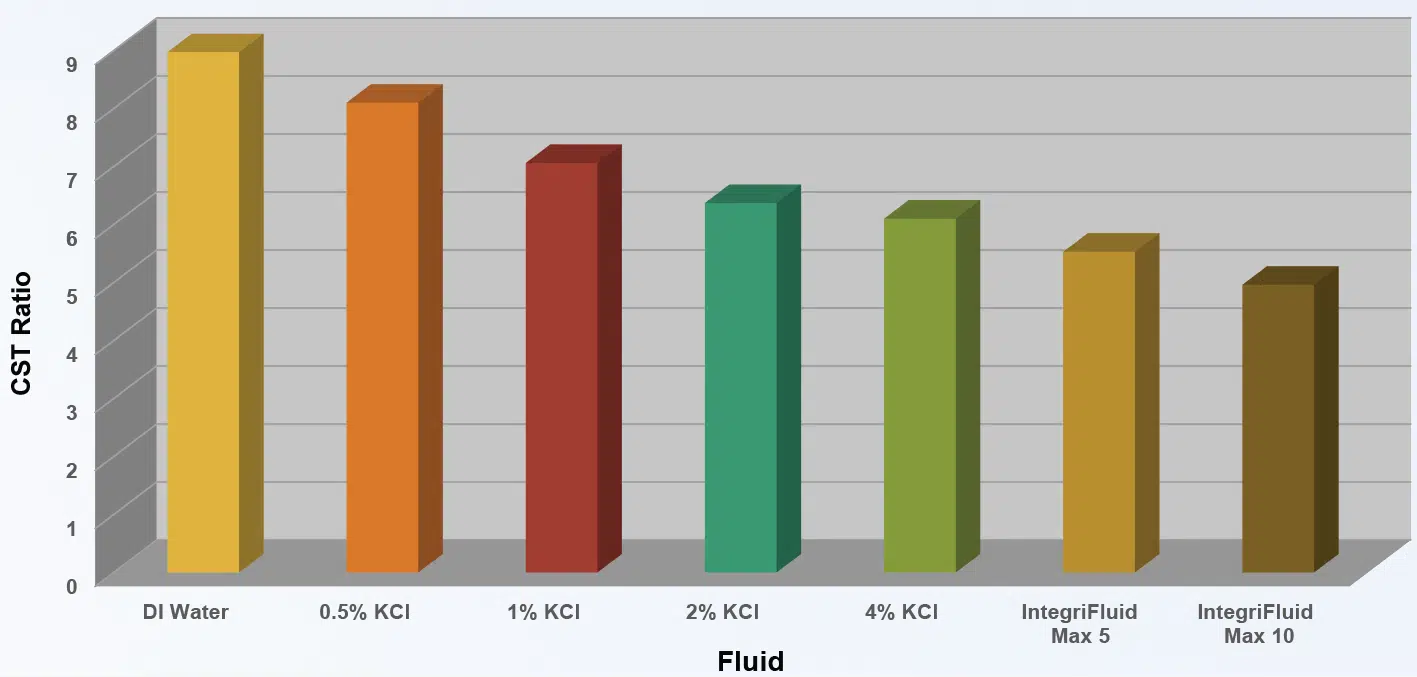
Capillary suction time (CST) is one test referenced in Envirotx materials. The company reports compiled CST comparisons using Wolfcamp shale samples from Texas, with IntegriFluids Max 10 producing the strongest CST reduction among the tested IntegriFluids products and potassium chloride concentrations, followed by Max 5. These results are specific to the stated samples and comparison; they should not be treated as a universal outcome for every formation.
How Envirotx IntegriFluids Support Downhole Clay Control
Envirotx supplies IntegriFluids clay-control fluids for fracturing and other well interventions. The product line is designed to reduce clay swelling and fines migration through interaction with clay, shale, and reservoir colloids.
IntegriFluids Max 5 and IntegriFluids Max 10 are functionalized, dual-purpose fluids positioned to address hydration of reactive clays and fines migration in one treatment approach. Envirotx product information describes the Max line as using biopolymer chemistry that anchors to clay surfaces and supports encapsulation of formation colloids.
What Envirotx can help teams review
- Whether the application involves clay swelling, fines migration, or both
- How IntegriFluids fit the planned fracturing or well-intervention fluid system
- Which product information and safety information are needed for evaluation
- What supply format is appropriate for the project volume
- Which questions should be resolved through compatibility and formation testing
Envirotx lists IntegriFluids availability in totes, truckload quantities, and railcar quantities. Project teams should confirm current packaging, logistics, product specifications, and technical documentation directly with Envirotx for the planned job.
Frequently Asked Questions About Downhole Clay Stabilizers
What is the purpose of a clay stabilizer in a well?
A downhole clay stabilizer is used to reduce the susceptibility of reactive clay and shale to water while helping control mobile fines. It is added as part of a fracturing or well-intervention fluid system when those formation-damage mechanisms are a concern.
Are clay swelling and fines migration the same problem?
No. Clay swelling is the hydration and volume change of water-sensitive minerals, while fines migration is the movement of small particles through the formation. A fluid system may need to address one or both mechanisms.
How do IntegriFluids Max 5 and Max 10 control clay?
Envirotx describes Max 5 and Max 10 as functionalized biopolymer fluids that interact with clay surfaces and encapsulate reservoir colloids. They are designed to control both reactive-clay hydration and fines migration.
Can a clay stabilizer be used with other treatment additives?
Envirotx states that IntegriFluids are compatible with known kill, acidizing, and fracturing additives. The complete fluid package should still be reviewed and tested for the specific formation and treatment conditions.
What testing can support clay stabilizer selection?
Testing should reflect the formation material, treatment water, additive package, and operating objective. Envirotx cites capillary suction time comparisons for Wolfcamp shale samples, but teams should use results that are relevant to their own application.
Is a downhole clay stabilizer the same as a roadway soil stabilizer?
No. A downhole clay stabilizer is a fluid additive for oil-and-gas wells. A roadway soil stabilizer is used to modify or improve soil in subgrades, bases, unpaved roads, and other civil construction applications.
Match the Clay-Control Fluid to the Formation
Downhole clay stabilization is most useful when the treatment is selected for the actual formation response and fluid package. Envirotx can help completion and production teams review IntegriFluids Max 5 and Max 10, available technical information, compatibility considerations, and supply needs for a planned fracturing or well-intervention program.
Talk to an Envirotx Specialist